
Views: 0 Author: Site Editor Publish Time: 2026-09-17 Origin: Site


If a workshop has already confirmed ZF 8HP70, it may seem that the torque converter should be straightforward to identify.
ZF's own application data shows otherwise. The same 8HP70 transmission designation appears with different torque-converter numbers in different engine applications, while different 8HP variants can also share the same converter number.
Transmission code narrows the candidate set. It does not, by itself, establish the final torque-converter identity.
The useful question is therefore not simply “Which converter fits an 8HP70?” It is: which converter number is mapped to this exact transmission and powertrain application?
Listed by ZF for selected Jaguar 3.0L 8HP70 / 8HP70HIS applications.
Listed by ZF for selected Jaguar 5.0L 8HP70 / 8HP70HIS applications.
ZF catalog data shows this converter number across selected BMW 4.4L 8HP70 and 8HP70X applications.
The table below uses examples from ZF's official remanufactured-transmission application catalog. The point is not to use a historical catalog as a current ordering list; it is to examine the manufacturer's own mapping between transmission, engine/application and torque-converter identity.
| Application Example | Transmission | ZF Torque Converter No. | What the Record Shows |
|---|---|---|---|
| Jaguar 3.0L RWD, non start-stop | 8HP70 | 1087 322 276 | 8HP70 does not resolve to one universal converter. |
| Jaguar 3.0L RWD, start-stop | 8HP70HIS | 1087 322 276 | A transmission suffix change does not automatically change the converter. |
| Jaguar 5.0L RWD, non start-stop | 8HP70 | 1087 322 291 | The same 8HP70 designation appears with another converter in a different engine application. |
| Jaguar 5.0L RWD, start-stop | 8HP70HIS | 1087 322 291 | The engine/application relationship remains more informative than the suffix alone. |
| BMW 4.4L selected application | 8HP70 | 1087 322 400 | A third converter identity appears within the broader 8HP70 family. |
| BMW 4.4L xDrive selected application | 8HP70X | 1087 322 400 | Different 8HP variants can share the same converter number. |
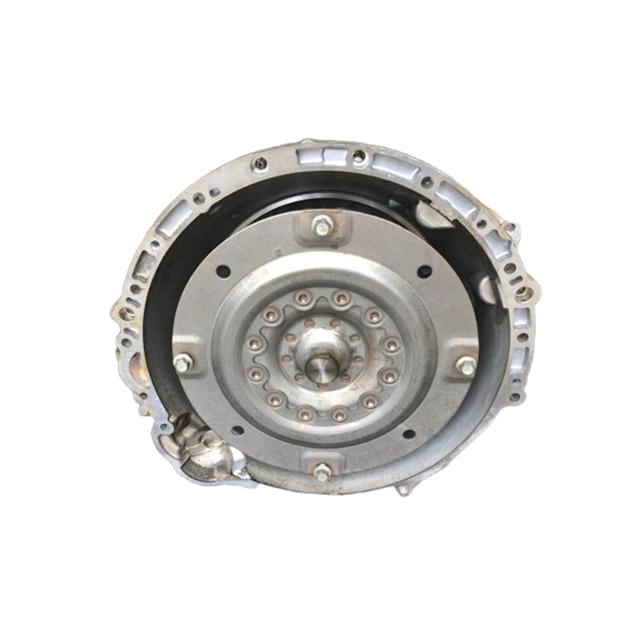
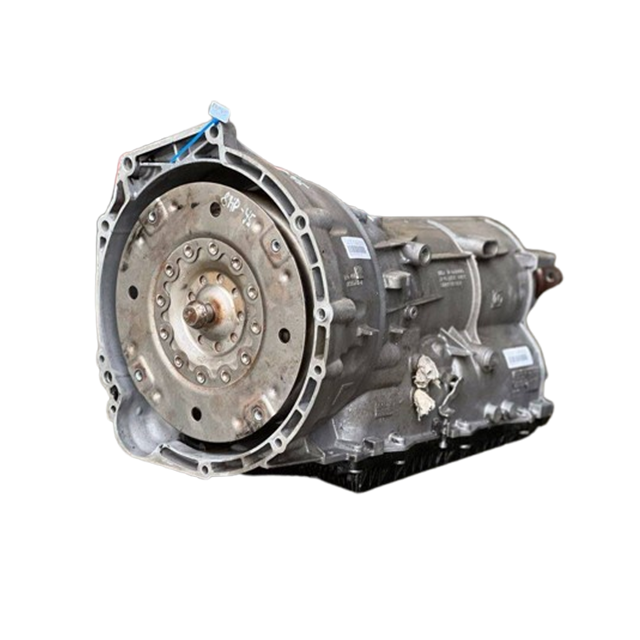
Image note: These are existing Super5 product images from super5gearbox.com. They are used as application-context visuals, not as evidence that every 8HP70 or 8HP45 uses the same torque converter.
When the same transmission code appears with multiple converter numbers, the matching problem becomes an application-mapping problem rather than a simple model lookup.
The relationship is therefore better expressed as:
No single field replaces the others. The value comes from confirming that the fields point to the same application.
ZF's own torque-converter technical information explains why application data matters. ZF states that its passenger-car torque converters can be individually tuned for different driveline designs.
The lock-up clutch uses a modular design with different numbers of friction surfaces and different hydraulic circuit diameters. ZF also describes torsional damping systems designed to manage the higher torsional vibration associated with modern engines producing substantial torque at low engine speed.
That engineering background explains why two converters can belong to the same transmission family without being the same product internally. A transmission code tells us where to look; it does not describe every lock-up and damping characteristic packaged inside the converter.
Super5's existing ZF 8HP Parts Map already treats 8HP45, 8HP50, 8HP70, 8HP75, 8HP90 and related variants as transmission-level context rather than universal parts-matching numbers.
For torque converters, the transmission family is therefore used to narrow the search, while the converter record remains tied to the application and the original converter identity.
For Super5 parts data, the useful record connects the converter to the exact transmission and the powertrain application, then retains the converter/OE identity and physical cross-check information.
Exact 8HP designation or verified transmission identity.
Engine/application and relevant driveline configuration.
ZF number, OE number or original converter code.
Hub, mounting pattern and old-part structure where needed.
This distinction prevents two opposite data errors: merging different converters because they share one transmission family, or splitting the same converter into duplicate records simply because the transmission suffix differs.
The hardest cases are not the ones with a clean ZF or OE number. They are converters that have been rebuilt before, cleaned aggressively, corroded, relabeled or installed during an earlier transmission replacement.
When the original converter identity is incomplete, Super5 does not replace it with one new “magic” identifier. The match is rebuilt from independent evidence.
Establishes the correct transmission context and removes unrelated converter families.
Separates applications that can share a transmission designation but use different converter identities.
Provides direct component identity when any original marking remains readable.
Provides a physical cross-check and can eliminate clearly incompatible candidates.
Help expose structural conflicts, but visual similarity alone is not treated as proof of internal equivalence.
This is the same evidence-separation logic used in Super5's Transmission Parts Identification Guide, where torque-converter matching is based on transmission application, engine, converter/OE code, hub configuration, mounting pattern and original converter identification.
Photos and measurements are valuable when they show that a candidate cannot be correct: a different hub, mounting pattern, pilot arrangement or shell geometry is a strong reason to stop and re-check the application.
The reverse conclusion is weaker. Two converters can look almost identical externally while the internal lock-up clutch or torsional-damping specification differs.
That is why physical comparison is best used as a cross-check, not as a substitute for converter identity.
The older ZF application catalog used in the examples above is evidence of how ZF mapped transmissions, engines and converter numbers in those applications. It should not be treated as a 2026 ordering sheet.
Current ordering still requires current ZF/OEM information, including any supersession or service-number changes.
ZF's current remanufacturing catalog continues to list torque converters as distinct part-numbered products rather than collapsing them into a generic “8HP70 converter” category. That reinforces the underlying distinction between transmission family and converter identity.
A strong match is not simply:
“The vehicle has an 8HP70.”
It should establish that the exact transmission, powertrain application and converter/OE identity support the same part, with the physical converter showing no unexplained conflict.
That is the difference between a converter that is merely associated with an 8HP family and a converter whose application has actually been verified.
ZF Aftermarket: official remanufactured-transmission application catalog used for the historical 8HP70 / 8HP70X / 8HP70HIS converter-number examples.
ZF Aftermarket: passenger-car torque-converter technical information covering lock-up clutch modularity, driveline tuning and torsional damping.
ZF Aftermarket: current remanufacturing catalog used only to confirm that torque converters continue to be managed as distinct part-numbered products.

